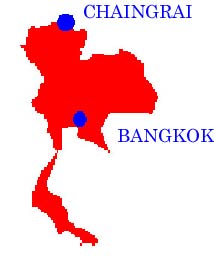
 |
 A collaborative research project under the Ministry of Public Health, Thailand & the Research Institute of Tuberculosis, Japan since1995 |
ORIGIN OF COLLABORATION
Thai Ministry of Public health (MOPH) and the Research Institute
of Tuberculosis (RIT), Japan has a long history of collaboration
since1963 when two MOPH staff members joined the first international
training course in RIT. Over 100 Thais have been trained at RIT.
In 1995, TB/HIV Research Project was established in Chiang Rai,
based on this long-term relationship. Tuberculosis Division,
Department of Communicable Diseases Control (CDC), Chiang Rai
Provincial Health Office, Chiang Rai Regional Hospital (CRH),
and all community hospitals in Chiang Rai province and RIT are
participating in the collaboration.
 |
|
HIGH BURDEN OF TUBERCULOSIS IN HIV EPIDEMIC AREA
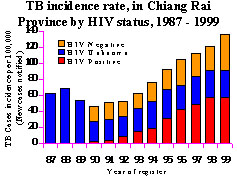
Chiang Rai is a province in northern Thailand where HIV epidemic was intense in early 1990s. Despite recent decline in HIV incidence, HIV epidemic has long term impacts for increase of TB cases in this province. New TB incidence rates per 100,000 population were 63 in 1997 and 50 in 1990 but increased to 117 in 1998 and 140 in 1999. Drug resistance was also high with MDR rate of 6.3% in 1996-1997. |
 |
RESEARCH ACTIVITIES:
(1) RESEARCH AND DEVELOPMENT FOR
TB CONTROL
The surveillance on TB and HIV in the province was
initiated in early 1996. All AFB-positive pulmonary TB cases
in Chiang Rai have been identified, interviewed, and sent for
culture and drug susceptibility testing. The project also maintained
the computerized TB registry system from 1987 and mortality database
from 1995 under Chiang Rai Provincial Health Office. This database
has been integrated into the routine TB information system of
the province. It is expected that rate of drug resistance will
decline after strengthening of the TB control measures through
DOTS implementation. TB research is expanded to study molecular
epidemiology based on DNA fingerprinting and other genetic information
of TB isolates (with collaboration with Mahidol University and
BIOTEC) and also find ways to prevent transmission to the household
contacts and community.
 |
(2) PREVENTION OF NOSOCOMIAL Mycobacterium tuberculosis TRANSMISSION
Chiang Rai Hospital and the HIV/AIDS Collaboration (HAC), a joint activity of Thai MOPH and US CDC, had initiated a cross-sectional study on “Risk of Nosocomial Mycobacterium tuberculosis Transmission Among Health Care Workers”in 1995-1996. This cross-sectional study detected increased risk of TB infection related to health care workers occupational exposure at CRH. Due to the public health importance of this finding, CRH and HAC decided to set up a long-term follow-up study together with TB/HIV Research Project and RIT in 1997.
 |
(3) SOCIO-CULTURAL DIMENSION OF TB/HIV
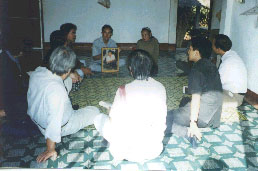
Vice Director of RIT has encouraged a Thai social scientist and research fellow of the project to conduct social science research on TB for her PhD study. There are three sub studies, namely (1) focused ethnographic study, (2) health seeking behavior, and (3) study on coping mechanism. This study made us understand how the community stigmatized TB again in relation to HIV/AIDS. The study results have been translated into actions for TB and HIV/AIDS untrol, especially for the training activities.“Convincing Tuberculosis Patients by Conducting Effective Home Visits”is being prepared . |
 |
(4) COHORT STUDY OF DRUG USERS AT
MAE CHAN
With the initiation of Dr. Pathom Sawanpanyalert and Mae Chan
Hospital, the cohort study was set up after the feasibility survey
and the protocol approval by the ethical committee of MOPH in
1998. We will move this cohort study to measure TB-related morbidity
and mortality in addition to HIV prevalence, incidence and their
risk factors.
(5) RESEARCH AND DEVELOPMENT AT CHIANG
RAI HOSPITAL BLOOD BANK
Dr. Pathom has also worked with the Project to maintain the donor
registry database system at Chiang Rai Blood Bank since 1989
to improve blood safety, particularly by reducing HIV window-period
risk.
HUMAN RESOURCE DEVELOPMENT
AND TECHNICAL COOPERATION:
Through various means, the project has assisted several academic
activities for both locally and internationally:
* Supporting Thai medical and health policy makers and staff
for TB and HIV/AIDS training in Japan
* Organizing regular provincial TB meetings
* Serving as trainers for TB and HIV/AIDS training in Chiang
Rai and provinces nearby, including the international training
courses in Japan * Serving as resource persons for the national
meetings on TB research and the international meetings in neighboring
countries
* Serving as referees for a TB international journal
  |
|
 [Chiang
Rai]
[Chiang
Rai]